As transgender issues become a part of medical discourse and as the “trans communities begin to assert themselves as marginalized and unserved through dominant models of health care” (C. Farahbakhsh, personal communication, December 30, 2015), I would contend that conversations around cis-privilege have been entirely reductive in nature as cis people are typically who constructs the narratives. I believe this is perhaps due to a lack of actually work in partnership with trans communities. “As the medical system primarily operates from a cis perspective and standard of care, this lack of trans inclusion can be traced back to a lack of community consultation, involvement, lack of comprehensive education/ curriculum, and erasure of trans experience and contribution in medical spaces” (C. Farahbakhsh, personal communication, January 4, 2016) which has been quite detrimental to members of these communities as they continue to have meaning imperialistically ascribed to their lives, bodies and experiences. This can only act to perpetuate the systemic trauma that these communities experience as they are continually and forcibly subjected to occupying space within a society in which many members do not even have a basic understanding of how cis-privilege impacts and shapes trans lives.
As a white cisgender queer healthcare professional and in an attempt to collaborate, I consulted with my local gender justice center, South House, prior to beginning this series of blog posts. With the intention of making the series as accessible as possible to cisgender healthcare professionals, my goal is to initiate a conversation that would center trans-healthcare through an act of solidarity in creating a space that would invite trans voices to disrupt the cis narrative that governs medical institutions. After what seemed like a meaningful dialogue, I realized that the first step to my success may be to create an awareness around the all too often left unsaid term, cis, and to attempt in exposing how this assumed gendering furthers practices that reproduce and protect the privileging of cisgender people.
It is far beyond the scope of this post to attempt in explaining the heterogeneity of the trans communities as they are incredibly diverse, however it is necessary to explain that their members do not experience the same congruency that cisgender people have between their gender identity and the sex they were assigned at birth. Similarly, unearned “[c]isgender privilege is given to persons whose morphology aligns with socially-sanctioned gender categories” (Johnson, 2013, p. 138). The associated structural impacts on trans lives are seemingly endless in that cis-privilege shapes public space. This is particularly evident in spaces in which vulnerability is inherent, including but not limited to bathrooms, prisons, shelters and of course healthcare (Johnson, 2013). Therefore, these spaces become shaped by a gender dominance that privileges the socially-sanctioned binary system of gender; cissexism reinforces cis-privilege and transphobia further victimizes those who are gender non-conforming (Johnson, 2013).
I feel it is important for healthcare professionals, particularly those who are queer identified, to start reflecting on how some members of LGBTQ communities are excluded from the dominant models of healthcare that shape medical space. For me, this continues to be a lesson in inclusion and a way to further the interests of LGBTQ communities by strengthening us and uniting us as a diverse population who shares in being structurally marginalized. I believe this is an incredibly important conversation to have given that trans comprehensive healthcare is in its naissance. We must be critical about whether trans comprehensive healthcare is what it claims to be and consciously mitigate the risk of reproducing a medicalized white washed misappropriation of male privilege that could further marginalize transfeminine clients of color (C. Farahbakhsh, personal communication, December 30, 2015). How does the privileging of those who succeed in reinforcing the binary affect others and how does this intersect with those who are racialized or people who embody other forms of difference?
I am concerned by what I can only describe as what appears to be a dissent between queer cis and trans communities. I would argue that cis-privilege is becoming a problem within a queer context and that we are beginning to mirror some of the same challenges we face from normative culture. There are most definitely parallels between this issue and the cissexism and whitewashing of other (queer) issues and I would imagine these challenges will continue to become more complex if those who are both queer and privileged do not start engaging in conversations that they find difficult and uncomfortable. I have found it necessary to check my privilege as a white cis-gender queer woman. It has been an important step to situate myself within the work I wish to do as a nurse. I have had conversations where I have been misunderstood and my ignorance was met with hostility, however this has taught me that discomfort is often directly proportional to the degree of unchecked privilege a person enjoys. The more I learn about my own privilege, the more I understand that it can come at the expense of others and that this inequality creates a further marginalizing of populations that are already vulnerable. I cannot help my privilege however, I can continue to deconstruct my it and begin to create strategies on how to subvert the system and create points of leverage to further the interests of everyone who falls under the LGBTQ umbrella, not just the voices of those who embody socially-sanctioned versions of queerness.
Enlightening myself earned me nothing more than an awareness of how much I take for granted and how much I have to learn. I liken this learning process to a lifelong exercise in unpacking my privilege; checking it was merely the first step. I would suggest that you begin by situating yourself within the structure and consider how social practices create a hierarchy of privilege. Check your privilege and start talking. If everyone at the table looks like you and if they all agree with you then you are doing it wrong. We must seek out difference and embrace our own discomfort.
I have taken the first step in this process of unpacking the privilege I enjoy as a white cisgender queer healthcare professional. When I compare my privilege to some other members of the queer community, I realize how much work I can do and I invite you to join me in this learning process as I continue this critical conversation about queer healthcare (blogs will be posted January 28, February 18 & 24).
Source:
Johnson, J. R. (2013). Cisgender Privilege, Intersectionality, and the Criminalization of CeCe McDonald: Why Intercultural Communication Needs Transgender Studies. Journal of international and intercultural communication, 6(2), 135-144.

 B.S.Nursing, M.S. Nursing (Educator) and Ph.D Nursing (Research) from the University of Missouri – St.Louis. Neal is a post-doctorate fellow at the Watson Caring Science Institute, under the direct supervision of Dr. Jean Watson. He has an active research trajectory in Cameroon, West Africa. His research interests include maternal/infant HIV awareness and prevention via maternal feeding options. His keen interest in societal stigma, gender fluidity and philosophical narratives related to the Queer experience have led him to this important work with LavenderHealth!
 ebook outlets. The book is
  amazing on many different levels, among which was the experience of being part of a group of US citizens as the only openly LGBTQ person, and in a country where, among many other complicated issues, sexuality and gender rank high on the list. I joined this tour with my friend and colleague Leslie Nicoll, because as nursing journal editors we wanted to explore the feasibility of hosting an
  Cuban film ‘The Companion’ (‘El Acompanante’), which has been banned in Cuba until now. The screening we were able to attend was the first showing of the film in Cuba (see the trailer at the end of this post). The story is set in the early days of the HIV/AIDS crisis in Cuba, when those diagnosed with the virus were under mandatory isolation in a remote sanitorium. As people began to understand the disease, the Cuban government eventually ended this form of discrimination, but of course the stigma associated with HIV/AIDS remains. So the fact that this film was screened was a huge victory for LGBTQ activists in the country. Unfortunately, because of the US embargo against Cuba, the film is not accessible in the US, but hopefully this will change soon.
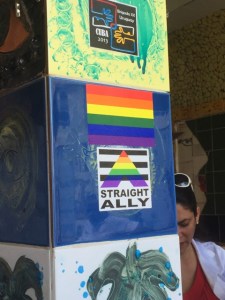 entire “kingdom” of ceramic mosaics, statues – all forms of visual art. We were served a delicious lunch right in the midst of his mosaic kingdom, and as we were beginning to pass around the family-style dishes, I looked up at a post on which our table was anchored .. and lo and behold, right there in front of me was a sighting! I immediately declared “a sighting” and pointed to the symbols on the post, in which Leslie immediately shared my delight. Sadly, the US physician sitting to my left, who had been participating in our early lunch banter, took one quick glance, looked away, and turned to a discussion at the other end of the table. Leslie and I shared a knowing glance … and went about enjoying our lunch!


 Lavender Health - LGBTQ Resource Center