Are you prepared to take action on behalf of LGBTQ health?

As the U.S. enters another frenetic and prolonged presidential election, it is worth taking note of the positions that elected officials, and those seeking office at every level of government hold related to LGBTQ health and well-being.  Regardless of your location in the U.S. or perhaps another country that is also embroiled in ongoing political struggle to secure the rights of LGBGQ people and families, it is time to reflect on what actions are possible to participate in bringing about full human rights for everyone in our communities.

A recent example of such action came gained broad public attention, and provides an excellent and inspiring instance that is worth noting.  Early in the Obama administration, they set up a web-based portal called “We the People” for anyone to submit a petition to draw attention issues that the U.S. government should notice. Of course there are many petitions that never gain traction, or that deserve to be ignored.  Others are quite noteworthy, such as the petition to enact “Leelah’s Law.”  This petition was published on January 3, 2015, seeking help from the Administration to ban the devastatingly harmful “therapies” known as conversion, or reparative approaches that claim to “cure” people of sexual and gender identities that do not fall within the traditional binary, heterosexual expectations.  The petition was titled “Enact Leelah’s Law to Ban All LGBTQ+ Conversion Therapy.” The law commemorates the life and death of Leelah Alcorn, a 17 year old transgender youth who wrote a suicide note, posted it on Tumblr and then walked in front of a semi-truck to end her life. Leelah’s parents had forced her to attend conversion therapy in an attempt to change her gender identity. The petition was signed by over 120,000 people. The administration responded supporting this ban, and expressed their position that resources for LGBTQ+ youth , their family and friends are a priority.  Click here to see the petition and the administration’s response.

This petition, and the administration’s response has given rise to a growing movement in the U.S. to take this kind of legislative action.  The list of current actions, even though most are in the very early stages of the political process, is quite impressive.  You can follow these actions on the NCLR web site here, and follow the #BornPerfect campaign to end conversion therapies.

We may feel discouraged and frustrated with what seems to be “little we can do,” but this is not an excuse for taking the cowardly path to do nothing.  It is time to make a commitment to be well-informed of the issues that affect the well-being of our LGBTQ communities, know the public officials at every level who support us, and take every action possible to make sure they act on our behalf.  Choose an issue that you care about, find an organization and other individuals to join in taking action, and seek the changes you envision!

Posted in Join the discussion | 1 Comment

The Barney Frank Story and the “Indiana” discrimination law

Barney Frank’s autobiography is a book I highly recommend for all who are interested in the political process and one gay man’s experience of struggling with the challenges of coming out as a public figure. He titled his book “Frank: A Life in Politics from the Great Society to Same-Sex Marriage.”  Frank makes it abundantly clear that political change in the U.S. democracy depends in crucial ways upon the input that citizens provide to their elected representatives.  We see this unfolding currently with the public response to theAmazonSmile__Frank__A_Life_in_Politics_from_the_Great_Society_to_Same-Sex_Marriage_eBook__Barney_Frank__Books recent Indiana law that opens the door for institutional discrimination against LGBTQ people – a response that has had far-reaching and dramatic repercussions  nationwide!

Frank’s engaging wit along with his frank opinions and insights shine through brilliantly!  There are several things about the book that to me are fascinating, not the least of which is learning about Frank’s life.  He realized he was gay at the age of 14; at the same age he became passionately interested in the political process and realized that these two facts about himself were not compatible.  He saw no way, at that young age, how he could pursue his passion for politics (a very public realm) with his gay identity.  His way of coping with this reality was to determine to remain very closeted, pursued graduate study in political science, and cultivated key friendships and connections with friends and acquaintances who had some involvement in politics.  He describes his process of coming out – a process involving many years well into his public life as a U.S. Congressman, and covering many years during which he was an avid advocate for LGBT rights.

Frank’s self-reflections about his personal struggles, as well as reflections about his judgments (both right and wrong) concerning his political battles, illuminate not only Frank as a person, but both the private and the public “gay” experience in America over the past half century.  I gained a new and more optimistic understanding of the political process, and how important it is that each and every citizen become involved in advocating those causes that are important to us.  Frank has little regard for public demonstrations and protests – he sees these as too often reversing the positive efforts that can result in positive change, even if the changes are incremental and slow to come.  This is one point that I question (I believe we need all forms of activism in the direction of change), but I have a new appreciation and understanding of Frank’s point of view – one that he supports with specific evidence.

If you read only one book in the remainder of this year, let this book be at the top of your list!  It is informative, helpful, interesting and inspiring!

Posted in Political Process, Public Policy, Queer History | Tagged | Leave a comment

LGBT Health Awareness Week — a Good Time to Reflect on Your Personal Health

As Peggy Chinn wrote in last week’s Lavender Health blog post, it’s LGBT Health Awareness Week. Sponsored by the National Coalition of LGBT Health, the week is meant to increase awareness of LGBT health issues and to improve the competence of healthcare professionals and the healthcare system regarding LGBT health.

This seems like a good time to think about your personal health, your health promotion activities, and your routine health screenings.

Ask yourself these 10 questions:

1. Have you had an annual physical examination including gynecological exam in the last year?

2. Have you been to the dentist in the past 6 months?

3. Have you had a mammogram (if appropriate)?

4. Have you had a colonoscopy (if appropriate)?

5. Do you get the recommended amount of exercise every day or week (cardiovascular and weight/resistance training)?

6. Is your diet as healthy as it could be?

7. How much alcohol do you drink?

8. What is your weight?

9. Do you have social support (family, friends, co-workers)?

10. Do you find meaning in your life?

LGBT Health Awareness Week is now. If you have “room for improvement” in your personal health, why not take one step in the right direction, and do it today.  Why wait?

Posted in Join the discussion | Tagged , , , , | Leave a comment

13th Annual LGBT Health Awareness Week March 23-27, 2015

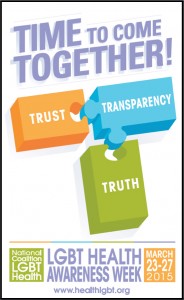
LGBT Health Awareness Week was established by the National Coalition for LGBT Health to promote increased health awareness and outcomes in the LGBT community and LGBT-Health-Poster-ss-with-border-184x300promote the need for greater cultural competency in the healthcare system. This year’s theme is “Time to Come Together: Trust, Transparency, Truth.” The emphasis is on using social media to build greater responsiveness and sensitivity to LGBT issues in the health care system (Trust), improved access to care for LGBT people and data collection that reflects sexual orientation and gender identity (Transparency), and underpinning these goals, support for all LGBT people to be open and honest about their sexual orientation and gender identities within the health care system (Truth).

Everyone can participate using your own social media connections!  Everyone is welcome to share the coalition’s social media campaign materials and use the hashtags: #TIMETOGETHER, #TIME4TRUST, #TIME4TRANSPARENCY, #TIME4LGBTTRUTH, and #LGBTHealthWeek throughout the week.  You can follow events and promotions throughout the week on the Coalition’s Facebook page.

You can also register here for a Webinar  focusing on “Trusting Relationships: Lessons from LGBT Health Centers Building Trust With Their LGBT Clients.” The webinar will be held on Wednesday, March 25, 2015, 4:00-5:00 pm EST.

For more information and even more ways to be involved, visit the Coalition web site!

Posted in Activism, Events, LGBT Health, News | Tagged , , , , , , | 1 Comment

Let’s get tobacco smoking out of the closet!

Tobacco smoking is the LGBTQ Community’s biggest health burden.  In 1964 the US Surgeon General issued the first report on smoking and health – a landmark report thathealth began a process of heightened awareness and action, about the health consequences of smoking tobacco.  But it was not until 2001 that the annual report mentioned LGB smoking disparities, and in 2014 the report finally clearly delineated what many LGBTQ researchers and health care professionals already knew — that smoking disproportionally affects all LGBT communities.The American Lung Association has also recognized the urgent health risks of smoking for LGBT people, identifying the LGBT community as a priority population for tobacco control.

In addition, we now know that there are many intersecting identities that add to the burden of stress for LGBT people and families, multiplying the health risks associated with smoking. Within our own community, youth, people of color, and people who are economically disadvantaged have a much higher rate of smoking and smoking-related health problems. As a community, we spend more on tobacco every year than is spent on programs to benefit LGBTQ people and famlies.  The smoking rate in the LGBT population is 68% higher than the rest of the population.  So it is time for all us – smokers and non-smokers alike, to speak out and reach out to raise awareness and participate in positive action.

Here is a typical story:

My smoking history is closely tied to my coming out as a lesbian – I smoked for about 10 years, off and on, during the early years of my lesbian life.  I cannot tell you which of these experiences was supposedly more closeted for most of those years – being a lesbian or smoking!  Some part of me felt that both were bad and struggled to come to terms with both, not ever realizing how closely related the two actually were although of course only one of them was “bad!”  Eventually, I began to realize that my sexual orientation was a part of me that I valued, I began to connect with a group of lesbian friends who were out and proud, and finally managed to stop smoking!

This story holds a key to understanding how we can all address this issue — we can live out and proud, and support those around us who may be ready to take the really difficult steps to stop smoking!  There are effective programs for smoking cessation, but they are sadly underused.  In the San Francisco Bay area, “The Last Drag” program offers free smoking cessation course 4 times a year .. the next session starts on April 1!  If you can’t find a local LGBT-focused cessation program, the American Lung Association offers help for all!  If you know of something that might help other LavenderHealth readers, share your comments and ideas here!  We welcome any and all suggestions!

smokinglgbt

Click image to download this Infographic from LGBT Healthlink!

Posted in Join the discussion | 1 Comment