Bad Blood?

What if you could potentially save nearly two million people with a simple regulatory policy change?

That question, according to a recent study by Ayako Miyashita and  Gary J. Gates for the UCLA School of Law’s Williams Institute, is not rhetorical. Ending the Food and Drug Administration’s (FDA) longstanding ban on blood donations by men who have sex with men (MSM) could result in an estimated 360,600 men donating an additional 615,300 pints of blood each year, an increase of 2 to 4 percent.

The FDA notes that its ban on blood from MSM donors emerged from policies early in the HIV/AIDS epidemic, though the current policy was formulated in 1992. This ban includes any man who has had sex with a man since 1977, which embraces Baby Boomers, Gen Xers, and the Millennial Generation. However, the FDA also acknowledges that:

The Health and Human Service’s Advisory Committee on Blood Safety and Availability (ACBSA) met to discuss the FDA MSM deferral policy on June 10-11, 2010. . . . The committee found the current donor deferral policies to be suboptimal in permitting some potentially high risk donations while preventing some potentially low risk donations [emphasis ours], but voted in favor of retaining the existing policy, and identified areas requiring further research.

Potential responsible MSM donors are faced with the ethical dilemma: Lie about prior sexual practices when donating blood or abstain from blood donor drives. That we use the term MSM to classify this population suggests some of the ambiguities and complexities of sexual identity, which further complicates the issue. In epidemiology, behavior (MSM) trumps socially constructed identity (gay or bisexual men). Further complicating matters is the question, What is sex?, which in the case of some sexual practices, as I pointed out here last spring, is not a settled matter.

Moreover, Miyashita and Gates note that:

In recent years, both the United Kingdom and Canada have made changes to their laws shifting from an indefinite deferral of MSM to a twelve-month and five-year deferral, respectively. In Mexico, new regulations have established criteria for blood donation based on risk factors for transmission of blood-borne diseases.

Blood has both a physiological dimension and a cultural dimension. As a physiological phenomenon it may be studied empirically, with an evidence based developed for sound policy. As a cultural phenomenon, blood exercises an imaginative power that is diffuse and pervasive.


Posted in Public Policy | 3 Comments

Columbia University School of Nursing Awarded Grant to Expand LGBTQ Elder Care in NYC!

This amazing grant was announced late in September, 2014Elder LGBT Interprofessional Care Program (E-LINC) is an interdisciplinary project headed by jkwongJeffrey Kwong, DNP, ANP-BC.  The main purpose of the project is to eliminate health disparities for LGBT elders living in New York City.  There are several key features of this project that are particularly notable!

  • The project is a partnership between the Columbia School of Nursing and SAGE: Services & Advocacy for LGBT Elders .
  • It draws on the expertise of interprofessional practice teams to provide the best culturally competent care possible.
  • The program provides personalized health and wellness plan based on initial assessments to identify physical and mental health risks.
  • The program is also designed to educate the next generation of health care providers as culturally competent to work with all LGBT individuals and commmunities.

Congratulations to Dr. Kwong, and to the team of providers and researchers who have made this project possible!

Posted in LGBT Elders, LGBT Health, LGBT Services | Tagged , , | 1 Comment

Wake Me Up Before You Go Go

Don’t you just love it when you read something that jolts you to attention; that makes you consider another perspective? I had that experience a few weeks ago when I read an article in the Hastings Center Report special issue on LGBT health, called “Repaving the road of good intentions: LGBT health and the queer bioethical lens.” The authors, Lance Wahlert and Autumn Fiester, really highlighted for me a distinction that I have somehow forgotten in the past few years; the difference between an LGBT health agenda and a queer health agenda. They reminded me that LGBT health research can unintentionally reinforce the marginalizing of some sexual minority patients and reinforce a heteronormative spin on cultural norms related to sexuality, gender identity, and the family. Their article begins with reference to a 1998 article by James Lindemann Nelson called “The silence of the bioethicists” that lamented the lack of attention to trans* health issues. He followed this in 2012 with an article called “Still quiet after all these years.” I wish I had known of this article when we were writing about nursings’ silence on LGBT issues! Wahlert and Fiester go on to suggest that the IOM report on LGBT health has an effect of reinforcing heterosexism and silencing those with the most marginalized identities. One example they use is the recommendation for electronic health records to include sexual orientation and gender identity questions. The authors’ analysis of this is:

“This seemingly innocuous recommendation…is profoundly loaded for LGBT patients, yet there is only a perfunctory nod toward the ‘hesitancy on the part of patients to disclose this information.’” The authors suggest that the recommendation is “not a serious examination of the root causes or legitimate concerns underlying LGBT persons’ reasonable and anticipated hesitancy about such disclosure. In fact, in treating this information as if it were purely (and neutrally) demographic, the IOM report naively (or obtusely) fails to recognize its complicity in reinforcing stigma. It sanctions probes for disclosure about desires, relationships, sexualities, and gender presentations of those who are non-normative and often societally disdained.”

In other words, health care providers are urged to press their patients for personal information, without corresponding education to teach health care providers about why disclosure might be dangerous for some of their patients, and without preparing them for how to respond to non-normative answers to their questions. On the part of the patient, a perception of being coerced into disclosing to a health care provider for whom they may lack knowledge of attitudes about LGBTQ issues, may lead to feelings of shame, guilt, and fear (and avoidance of health care).

Wahlert and Kriester note “you miss the stakes involved in asking such questions only if you are safely enveloped in the normative fold.” They admonish LGBT health researchers who have been at least somewhat embraced by health research disciplines as “legitmate,” to consider whether their needs for data is elevated above the potential harm to already marginalized LGBTQ patients. I’m not sure where my reflections on this piece will take me. I’ve made this plea for data collection on sexual and gender identities many times myself, and I’m a tenured professor in the “normative fold” of the academy. Have I forsaken my less fortunate LGBTQ family members in my quest for understanding health disparities? So, thank you Lance Wahlert and Autumn Fiester for the much needed wake-up call!

Posted in Join the discussion | Leave a comment

Victory in California!

lgbt_rainbow_justice_scaleIf you have not heard, California Governor Jerry Brown signed into law a bill that includes specific recommendations for the inclusion of LGBTI health in continuing medical education (CME). The law amends the current cultural competence law to include information pertinent to the appropriate treatment of, and provision of care to, the LGBTI communities. If you want to read the law, click here. The law is actually quite short and very easy to read and understand.

If you have been a follower of our blog, you know that we have discussed (or at least mentioned) the need for all healthcare professionals to have cultural competency training specific to LGBT care (see these past blogs: here, here, and here). Thus, it was a nice surprise to see that this law was passed in California!

There is no doubt that physicians are integral to patient care. Patients often view them as an “authority” figure. A discriminatory experience with a physician can have dire consequences. The LGBT patient who experienced the discrimination may defer or delay seeing other healthcare providers, leading to negative health outcomes. Thus, I do not want to minimize the victory in California and the implications to appropriate care for LGBT people.

However, with this victory in hand, we must continue advocating for other professions to do the same. Nursing represents the largest healthcare profession in the United States. Nurses are often the first and last healthcare professional a patient sees. Also, the Affordable Care Act resulted in millions of people receiving health insurance and an increase in demand for primary care providers. As a result, the demand for nurse practitioners has increased. The new law in California will have no implications to nurses, including nurse practitioners. This type of mandated cultural competence education needs to be extended to ALL health professions, especially nursing.

GLMA has advocated for and supported the California bill since 2011. Although GLMA cannot be credited as the sole inspiration for this bill, their policy work definitely played a role. This is good news for the newly established GLMA nursing section, Nurses Advancing LGBT Health Equality. I hope that the new nursing leadership team can release similar cultural competency position statements. Other healthcare professionals reading this blog should pressure their professional organizations to do the same.

Posted in Join the discussion | Leave a comment

I’m Not Gay

All over the news and social media outlets this week are stories of the big photo-hacking iCloud leak of alleged images of celebrities in the nude. Celebrities such as Rihanna, Jennifer Lawrence, Kim Kardashian, Ariana Grande, Kirsten Dunst, Mary Kate Olson, and Liam Payne, among others. Some of these celebrities have confirmed the authenticity of the images (while threatening lawsuits), others have denied them claiming the images were Photoshopped.

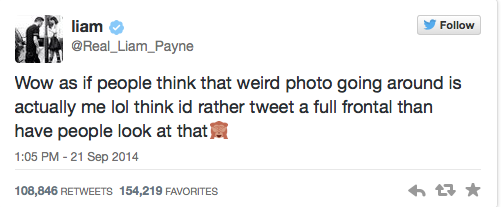
The image of Liam Payne, singer in the boyband One Direction, apparently was of him in the nude with a nude man. Payne cries foul and in more than one tweet, exclaimed that he isn’t gay and would not have been in that “weird picture.”

Screen Shot 2014-09-23 at 10.44.58 AM

Screen Shot 2014-09-23 at 10.45.30 AM

Granted, Liam Payne is not the first nor will be the last celebrity to be rumored to be gay. A recent Huffington Post post lists 38 recent examples, from Vin Diesel to Tom Cruise.

What troubles me was Payne’s recent response.  He could’ve simply denied that the image was really him.

The LGBTQ movement has made such great strides in recent months and years. It’s time to state clearly and unequivocally that a exclaimed statement such as “I’m not gay!” is homophobic. Let’s not pretend that it isn’t.

Posted in Join the discussion | Leave a comment